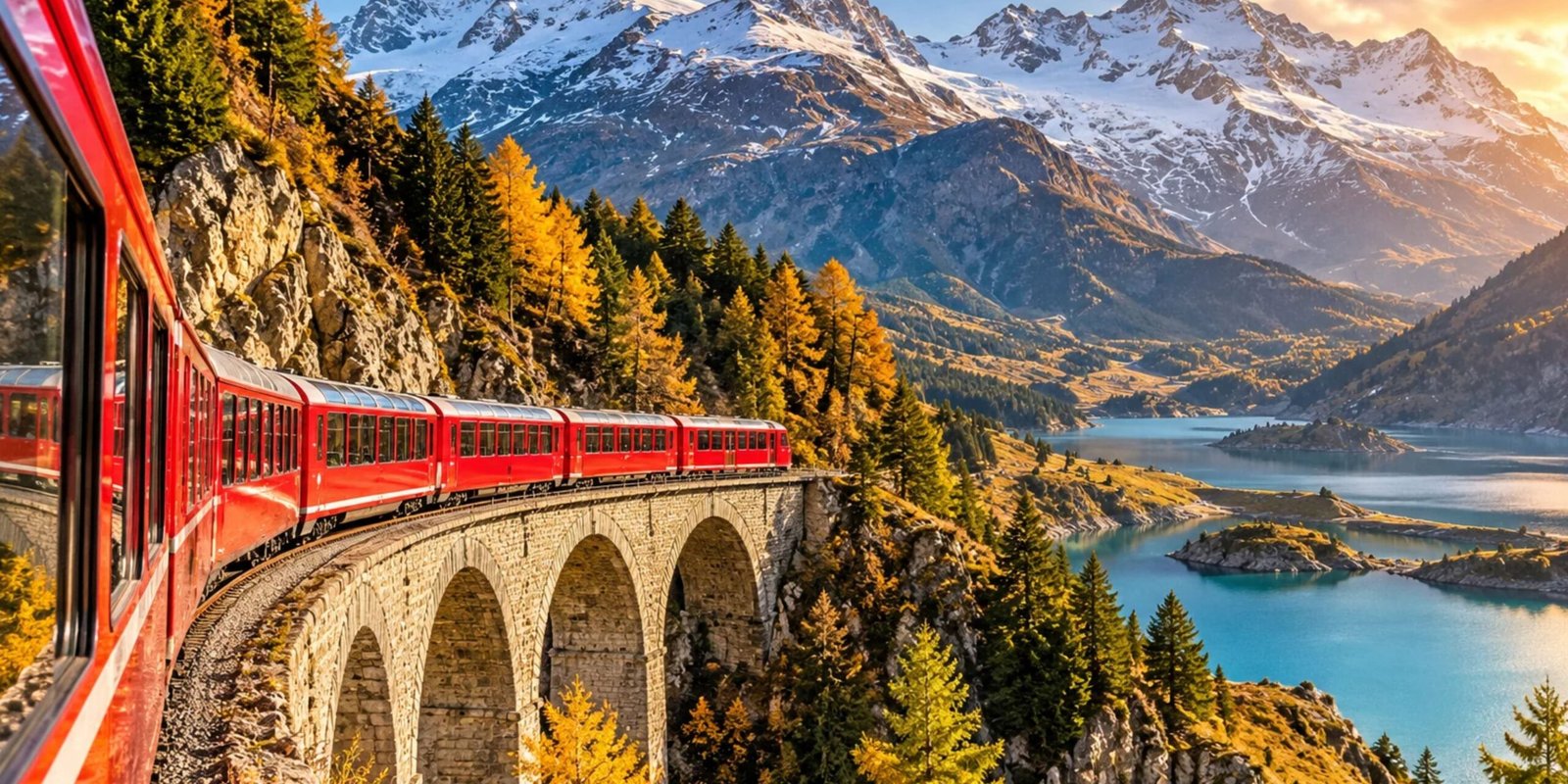

Some of Europe’s most beautiful landscapes are best seen from a train window. Think snow-covered mountains in Switzerland, deep Norwegian fjords, vineyards along the Rhine, and little Italian villages perched above the Mediterranean.
The best part is that you don’t necessarily need an expensive luxury train ticket to enjoy them. Some of Europe’s most scenic railway routes are regular public transport services, while others offer panoramic carriages, historic steam trains, or overnight journeys through the mountains.
If you’re planning a European holiday, these 12 scenic train journeys are worth considering. Each offers something different, from short mountain excursions to full-day adventures that take you across borders.
You’ll also find practical details about routes, journey times, the best seasons to travel, and how to avoid paying more than necessary.
1. Bernina Express, Switzerland and Italy
Route: Chur or St. Moritz, Switzerland, to Tirano, Italy
Journey time: Approximately 4 hours from Chur or 2 hours 15 minutes from St. Moritz
Best time to visit: June to September for green valleys, or January to March for snowy landscapes
The Bernina Express is one of the few train journeys where you can travel from a high Alpine landscape to an Italian town surrounded by a much milder climate in a single afternoon.
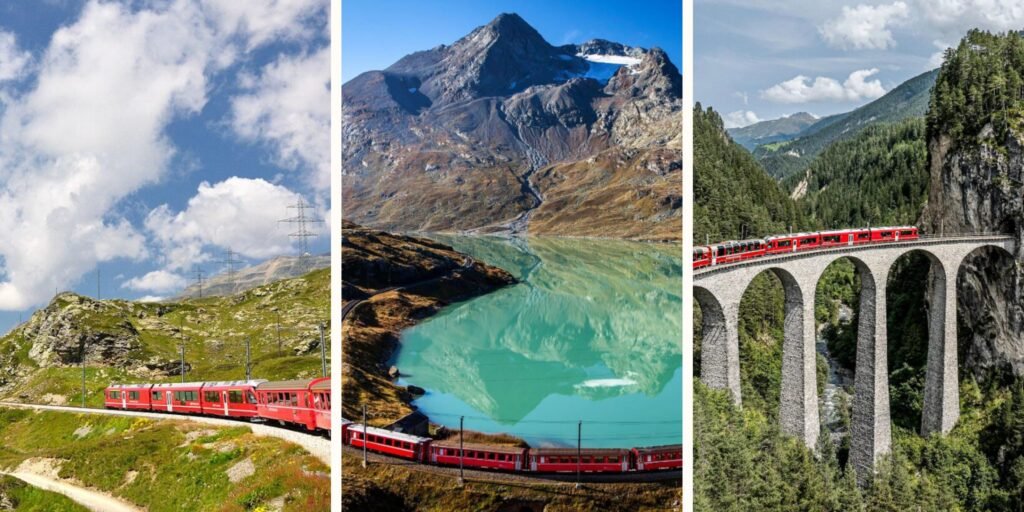
The journey begins among Switzerland’s mountains, passes glacial lakes and rocky peaks, and eventually descends through the Poschiavo Valley into northern Italy.
One of the most photographed sections is the Landwasser Viaduct, where the train curves across a tall stone bridge before entering a tunnel cut into the mountainside. This landmark is on the Chur route, so passengers boarding at St. Moritz won’t pass it.
Further along, the train climbs toward the Bernina Pass, where you’ll see Lago Bianco and dramatic mountain scenery. The line reaches more than 2,200 metres above sea level before descending toward Tirano.
2. Glacier Express, Switzerland
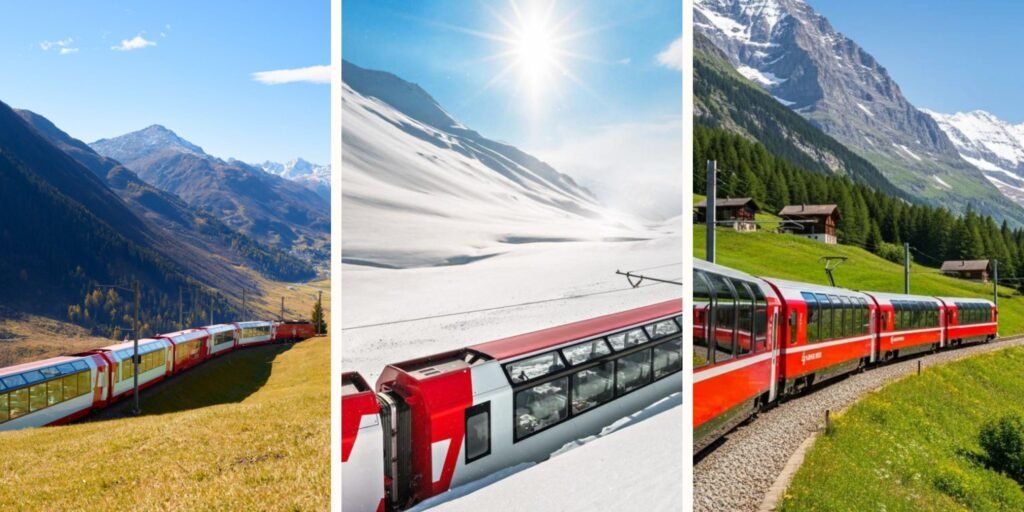
Route: Zermatt to St. Moritz
Journey time: Approximately 8 hours
Best time to visit: May to September for mountain scenery, or winter for snow
The Glacier Express connects two of Switzerland’s best-known mountain resorts, Zermatt and St. Moritz.
Despite its name, the train isn’t particularly fast. It travels slowly enough for passengers to enjoy the mountains, valleys, forests, and villages along the way.
The route passes through the Rhine Gorge, sometimes called Switzerland’s Grand Canyon, where pale rock walls rise above the river. It also crosses the Oberalp Pass, the highest point on the journey, at approximately 2,033 metres.
Another highlight is the Solis and Landwasser region, where impressive railway bridges make the journey especially interesting for photography.
The train’s panoramic windows extend high into the carriage, making it easier to appreciate the surrounding peaks without constantly leaning toward the glass.
You can order food on board, and passengers who want a more elaborate experience can choose premium accommodation. However, a standard second-class seat still gives you access to the same mountain views.
MUST READ===>> 10 Breathtaking Places to Visit Before You Die
3. Flåm Railway, Norway
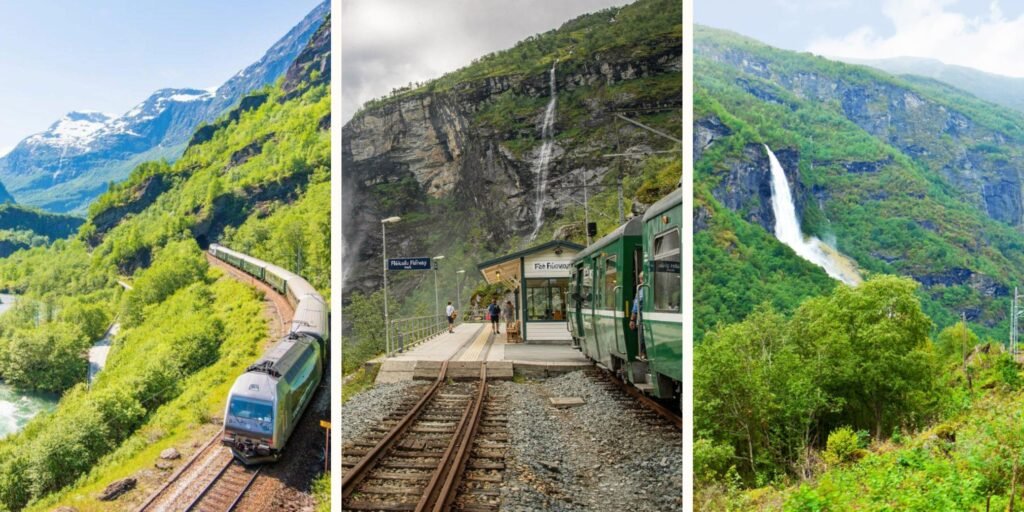
Route: Myrdal to Flåm
Journey time: Approximately 1 hour each way
Best time to visit: May to September for waterfalls and greenery
The Flåm Railway is a short journey, but it packs an extraordinary amount of scenery into roughly 20 kilometres.
The train travels between Myrdal, a mountain station on the Oslo–Bergen railway, and the village of Flåm beside Aurlandsfjord.
As it descends, the landscape changes from rocky mountain terrain to steep green valleys, rivers, and waterfalls. The railway uses tunnels and tight curves to navigate the dramatic elevation difference.
One of the main attractions is Kjosfossen, a powerful waterfall where trains normally make a brief sightseeing stop.
Flåm itself is a small village surrounded by towering mountains. It’s a good place to spend a few hours, especially if you want to combine the train ride with a fjord cruise.
4. West Highland Line, Scotland
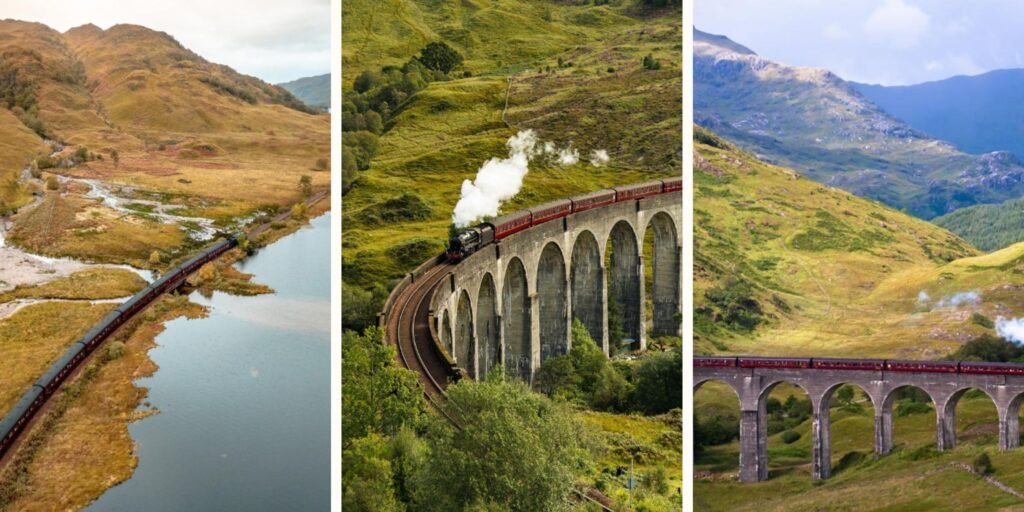
Route: Glasgow to Fort William and Mallaig
Journey time: Approximately 5–6 hours to Mallaig
Best time to visit: May to October
Scotland’s West Highland Line is ideal if you prefer rugged landscapes to polished mountain resorts.
The railway leaves Glasgow and gradually moves into the Highlands, passing lochs, open moorland, mountains, and remote countryside.
Around Rannoch Moor, the landscape becomes especially wild. Large stretches of the railway pass through open country with few buildings or roads.
Beyond Fort William, the route continues toward Mallaig on Scotland’s west coast.
This section crosses the famous Glenfinnan Viaduct, a curved stone railway bridge made internationally recognisable by the Harry Potter films.
The surrounding scenery is beautiful even if you’re not interested in the films. Loch Shiel, green hills, and distant mountain peaks create some of the best views on the journey.
5. GoldenPass Express, Switzerland
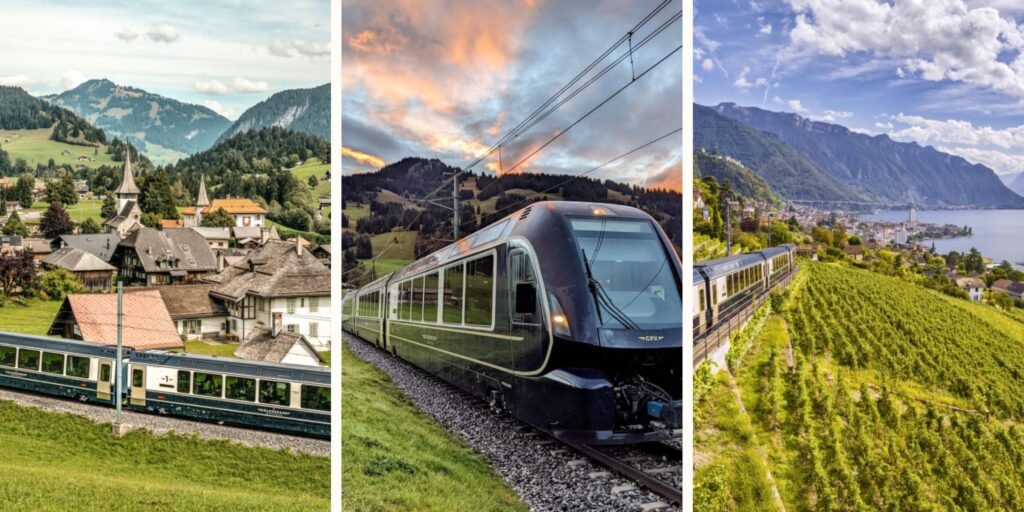
Route: Montreux to Interlaken
Journey time: Approximately 3 hours 15 minutes
Best time to visit: May to October, or December for winter scenery
The GoldenPass Express is an excellent choice if you want to see Switzerland’s lakes, mountain villages, and countryside without spending an entire day on a train.
The journey connects Montreux, on the shores of Lake Geneva, with Interlaken, a popular base for exploring the Bernese Oberland.
Leaving Montreux, the railway climbs above Lake Geneva, offering beautiful views over the water and surrounding vineyards.
The train then travels through countryside dotted with wooden chalets, farms, and traditional Swiss villages.
One of the most attractive sections passes through the Pays-d’Enhaut region, where green hills and mountain scenery create the sort of landscape many travellers associate with rural Switzerland.
The route continues through Gstaad and Zweisimmen before reaching Interlaken.
6. Bergen Railway, Norway
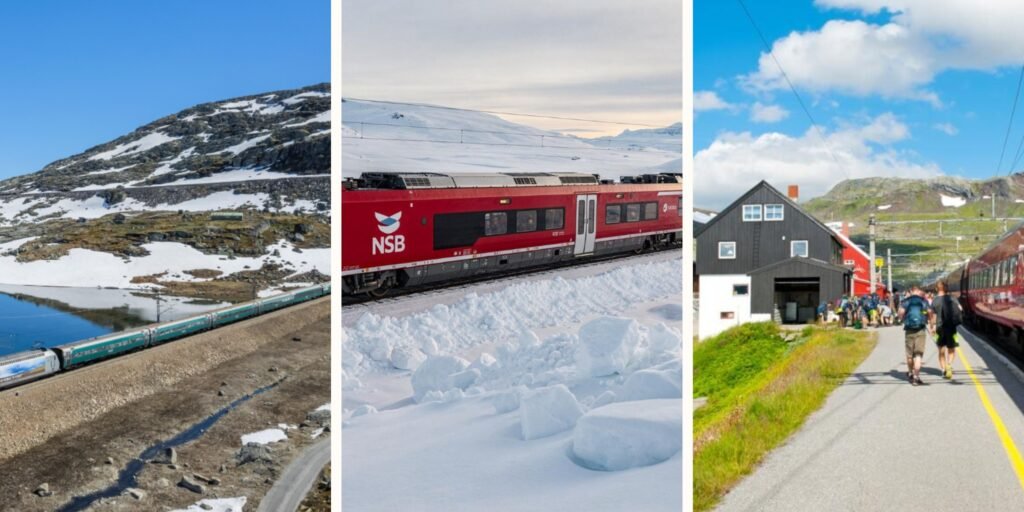
Route: Oslo to Bergen
Journey time: Approximately 6.5–7.5 hours
Best time to visit: June to September for hiking scenery, or February to March for snow
The Bergen Railway, also known as Bergensbanen, crosses some of Norway’s most remote mountain landscapes.
It connects Oslo, the Norwegian capital, with Bergen, a coastal city known for its colourful wooden buildings and access to the fjords.
The scenery changes considerably throughout the journey.
The train begins among forests, lakes, and small towns before climbing toward the Hardangervidda mountain plateau.
This is one of the most memorable parts of the route. The landscape becomes increasingly open, with rocky hills, mountain lakes, and stretches of land that can remain covered in snow well into spring.
Near Finse, the railway reaches its highest point, more than 1,200 metres above sea level.
The landscape here can feel surprisingly isolated, particularly in winter when snow covers the mountains and few buildings are visible.
As the train approaches Bergen, the terrain becomes greener, with valleys, rivers, and mountains surrounding the railway.
7. Cinque Terre Railway, Italy
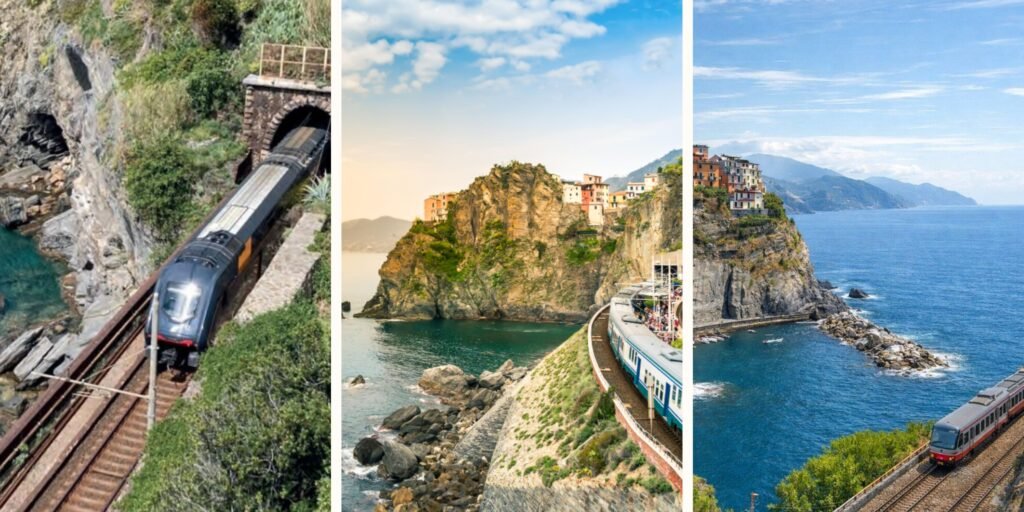
Route: La Spezia to Levanto, through the five Cinque Terre villages
Journey time: Approximately 30 minutes for the full regional route, depending on stops
Best time to visit: April to June or September to October
The Cinque Terre railway is different from Switzerland’s mountain trains. Here, the main attraction is a series of colourful coastal villages overlooking the Mediterranean.
The railway connects the five villages of Cinque Terre: Riomaggiore, Manarola, Corniglia, Vernazza, and Monterosso al Mare.
The line runs through numerous tunnels, with occasional openings that reveal cliffs, blue water, and small harbours.
Because much of the railway is underground, this isn’t a journey where you’ll enjoy uninterrupted coastal views for the entire ride.
Its real advantage is the ease of travelling between villages.
You can spend the morning wandering through Riomaggiore, stop for lunch in Manarola, and continue to Vernazza or Monterosso without needing a car.
Each village has its own character.
Manarola is known for its colourful buildings above a small harbour, while Vernazza has a picturesque waterfront surrounded by steep hills.
Monterosso has the largest beach of the five, making it a good place to relax after sightseeing.
ALSO READ===>> 15 Beautiful Christmas Villages and Towns in Europe for a Magical Winter Getaway
8. Rhine Valley Railway, Germany
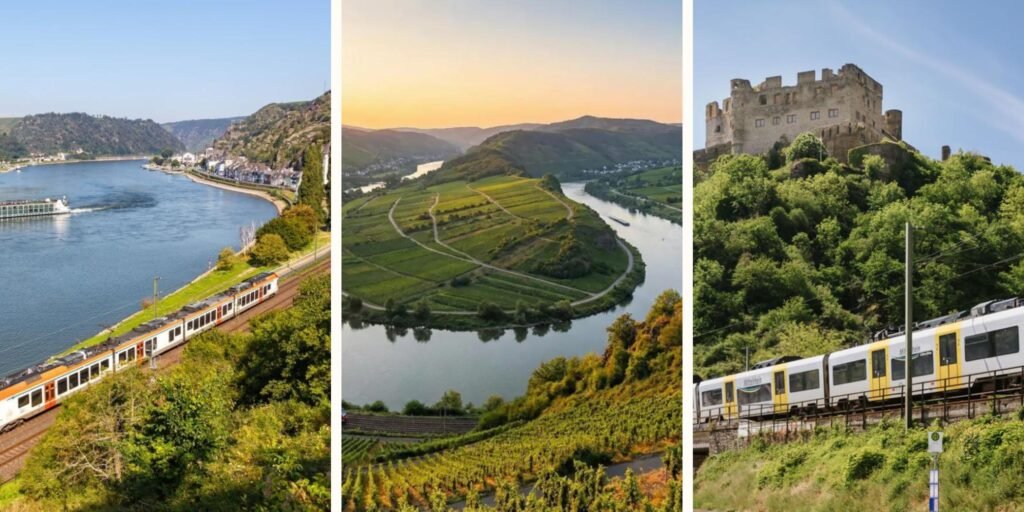
Route: Mainz to Koblenz, particularly the section between Bingen and Koblenz
Journey time: Approximately 1–1.5 hours, depending on service
Best time to visit: May to October
Germany’s Rhine Valley offers a completely different kind of railway scenery.
Instead of towering Alpine peaks, you’ll see vineyards covering steep hillsides, medieval castles, riverside towns, and boats travelling along the Rhine.
The most scenic stretch follows the Upper Middle Rhine Valley, a UNESCO World Heritage Site.
The railway passes historic towns such as Bacharach, Oberwesel, and Boppard, where traditional buildings sit close to the river.
One of the area’s best-known landmarks is Lorelei Rock, a steep cliff associated with German folklore.
Several castles can also be seen from the train, although visibility depends on which side of the river you’re travelling along.
9. Semmering Railway, Austria
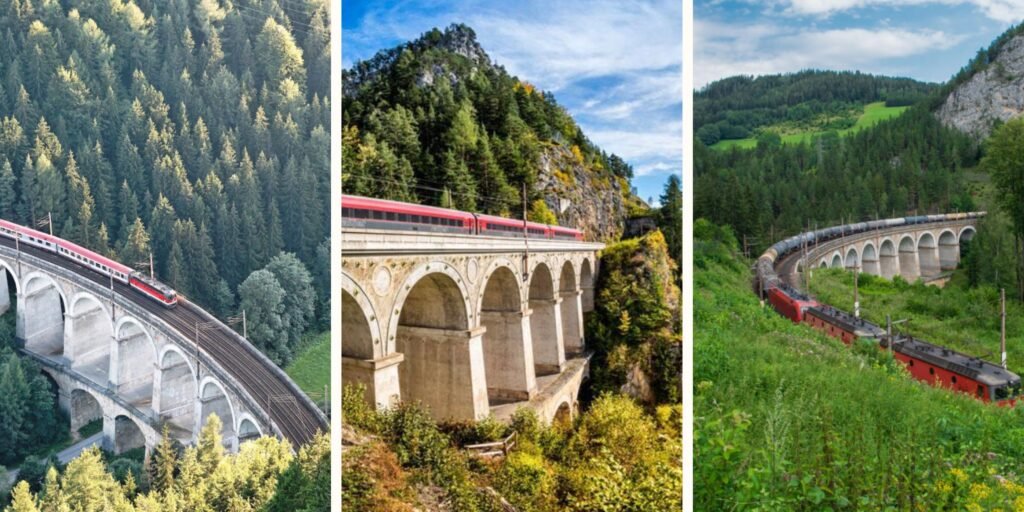
Route: Gloggnitz to Mürzzuschlag
Journey time: Approximately 45–60 minutes across the historic mountain section
Best time to visit: May to October, or winter for snowy forests
The Semmering Railway is one of Europe’s most historically significant mountain railways.
Built during the nineteenth century, it crosses a mountainous region of Austria using stone viaducts, tunnels, and carefully engineered curves.
The railway is recognised as a UNESCO World Heritage Site because of its pioneering engineering and the way it was constructed through difficult Alpine terrain.
Travelling along the route, you’ll see wooded hills, mountain valleys, historic bridges, and traditional Austrian villages.
One of the most impressive structures is the Kalte Rinne Viaduct, which crosses a valley on two levels of stone arches.
The route is particularly beautiful in autumn when the surrounding forests turn yellow and orange.
10. Douro Valley Railway, Portugal
Route: Porto to Pocinho, via Régua and Pinhão
Journey time: Approximately 3–3.5 hours one way to Pocinho
Best time to visit: May to June or September to October
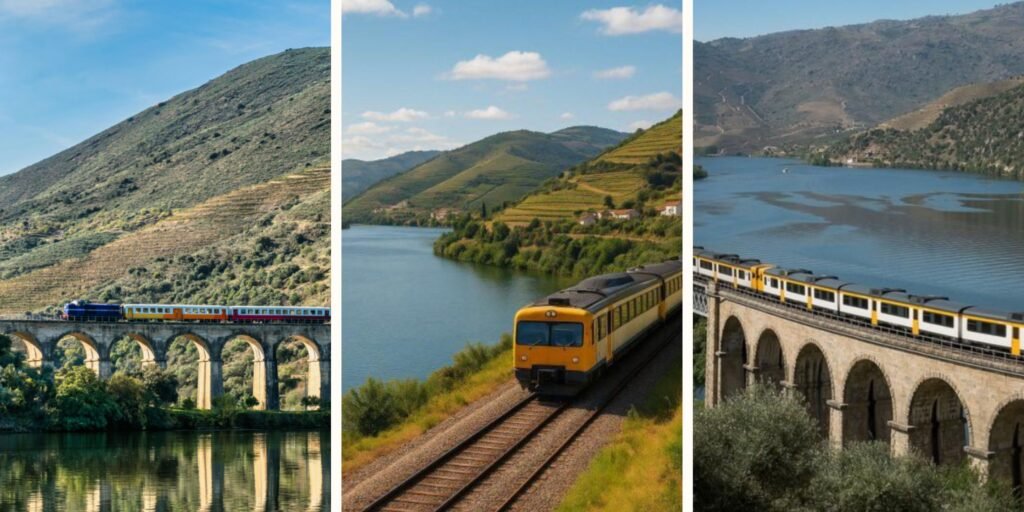
Portugal’s Douro Valley is famous for its terraced vineyards, traditional wine estates, and winding river.
The Douro railway line, known locally as Linha do Douro, follows the river through this beautiful region.
Leaving Porto, the journey initially passes through urban and suburban areas before reaching the more scenic countryside.
Beyond Régua, the railway travels close to the river, with steep vineyard-covered hills rising on either side.
The scenery is particularly attractive around Pinhão, a small town surrounded by wine estates.
Pinhão’s railway station is also worth seeing. Its traditional blue-and-white azulejo tiles depict scenes connected with the region’s wine production and local life.
11. Mont Blanc Express, France and Switzerland
Route: Saint-Gervais-les-Bains-Le Fayet to Martigny, via Chamonix and Vallorcine
Journey time: Approximately 2.5 hours for the full journey, including the cross-border connection
Best time to visit: June to September or December to March
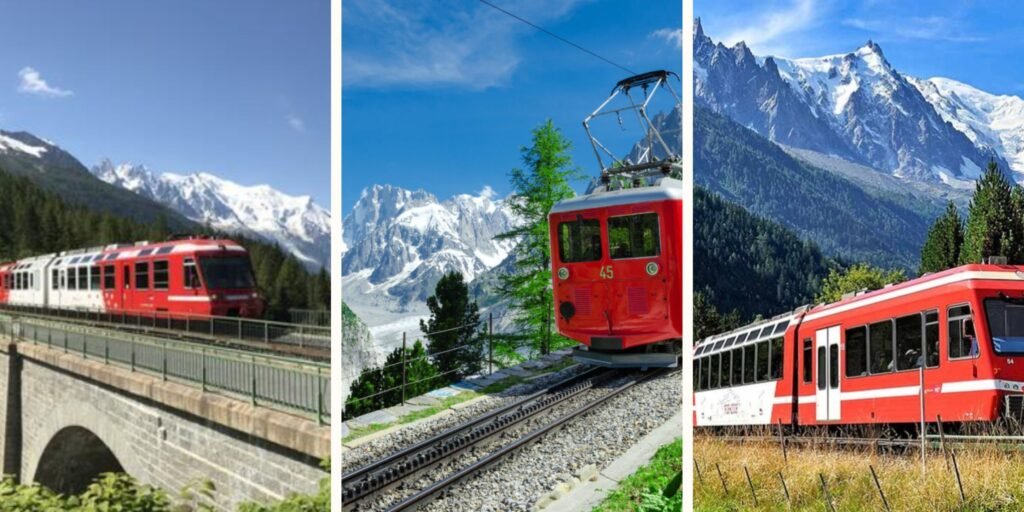
The Mont Blanc Express connects the French Alps with Switzerland through a series of mountain valleys.
It’s an excellent option if you’re staying in Chamonix and want to explore the surrounding region without renting a car.
The railway passes through Alpine villages, forests, and valleys surrounded by dramatic mountain peaks.
One of the most attractive sections runs between Chamonix and Vallorcine, where the train travels through wooded slopes with occasional views of the surrounding mountains.
Beyond Vallorcine, the route continues into Switzerland toward Martigny.
The scenery changes as the train descends through the Trient Valley, passing steep hillsides and mountain villages.
12. Belgrade–Bar Railway, Serbia and Montenegro
Route: Belgrade, Serbia, to Bar, Montenegro
Journey time: Often around 11–12 hours or longer, depending on the service and conditions
Best time to visit: May to September
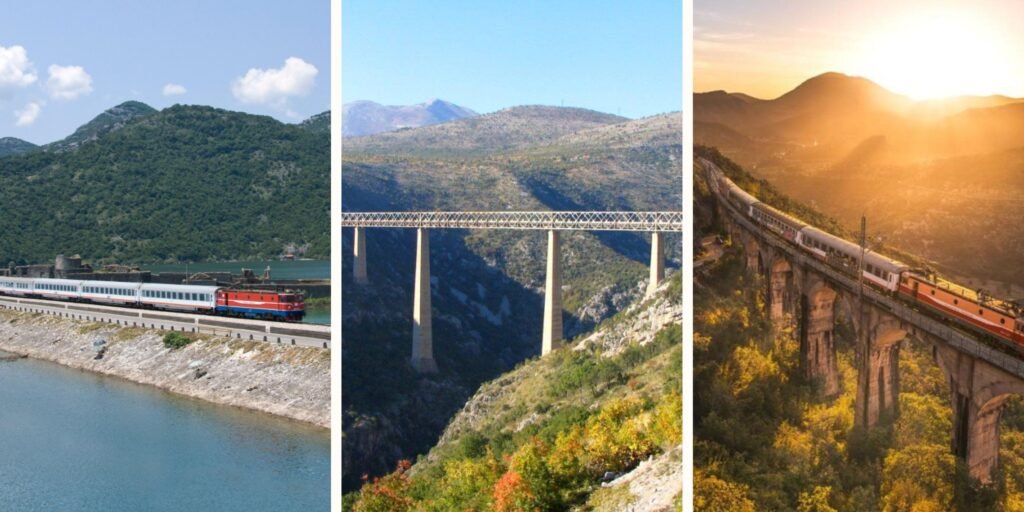
The Belgrade–Bar railway is one of Europe’s most dramatic long-distance train routes, particularly if you enjoy mountainous landscapes and less tourist-oriented destinations.
The railway connects Serbia’s capital with Montenegro’s Adriatic coast, travelling through river valleys, mountains, tunnels, and deep gorges.
One of the most impressive sections is the Mala Rijeka Viaduct in Montenegro, a very high railway bridge spanning a steep valley.
The route also passes through mountainous countryside before descending toward Lake Skadar and the coast.
Compared with Switzerland’s panoramic trains, this is a much more traditional railway experience.
Carriages and onboard facilities can vary, and the journey may take longer than scheduled.
However, the scenery is excellent, especially through Montenegro’s mountains.
Which Scenic Train Journey in Europe Should You Choose?
With so many beautiful railway routes, the best choice depends on the kind of landscape you want to see and how much time you have.
| Train journey | Best for | Approximate duration |
| Bernina Express | Glaciers and Alpine lakes | 2–4 hours |
| Glacier Express | Full-day Swiss mountain scenery | 8 hours |
| Flåm Railway | Waterfalls and steep valleys | 1 hour |
| West Highland Line | Wild Scottish landscapes | 5–6 hours |
| GoldenPass Express | Lakes and Swiss villages | 3 hr 15 min |
| Bergen Railway | Remote Norwegian mountains | 6.5–7.5 hours |
| Cinque Terre Railway | Colourful coastal villages | 30 minutes |
| Rhine Valley Railway | Castles and vineyards | 1–1.5 hours |
| Semmering Railway | Historic mountain bridges | 45–60 minutes |
| Douro Valley Railway | Vineyards and river scenery | 3–3.5 hours |
| Mont Blanc Express | Alpine villages and valleys | 2.5 hours |
| Belgrade–Bar Railway | Rugged Balkan mountains | 11–12+ hours |
For a first scenic train holiday in Europe, Switzerland is particularly convenient because its railway network makes it relatively easy to combine mountain journeys with visits to nearby towns.
Norway is a good alternative if fjords, waterfalls, and remote mountain scenery are your priorities.
If you’d prefer something shorter and less expensive, consider the Rhine Valley in Germany or the Douro Valley in Portugal.
MUST READ===>> 15 Breathtaking Ski Resorts in the USA for an Unforgettable Winter Getaway
Best Time of Year for Scenic Train Travel in Europe
The scenery can change dramatically depending on when you visit.
Spring: April to May
Spring is a lovely time for lower-altitude routes, particularly in Italy, Portugal, and Germany.
The countryside becomes greener, flowers begin to bloom, and temperatures are often comfortable for exploring towns between train journeys.
In the Alps, however, higher elevations may still be covered in snow, and some mountain hiking routes remain inaccessible.
Summer: June to August
Summer offers long daylight hours, making it easier to enjoy extended journeys.
It’s particularly suitable for Norway, Scotland, and the Swiss Alps, where longer days give you more opportunities for sightseeing.
The main drawback is demand. Popular panoramic trains and tourist destinations can become busy, especially during July and August.
Autumn: September to October
Early autumn is an attractive season for the Douro Valley, Rhine Valley, and many mountain railways.
Vineyards begin changing colour, and the countryside often has a beautiful mix of gold, orange, and green.
September can also be a good time to visit the Alps before winter conditions arrive.
Some tourist train services reduce their schedules or stop operating later in autumn, so check seasonal availability.
Winter: December to March
Winter transforms Alpine railway journeys.
The Bernina Express and other Swiss mountain routes can pass through snowy forests, frozen landscapes, and white mountain valleys.
Norway’s Bergen Railway is also particularly striking in winter.
The trade-off is shorter daylight hours, especially in northern Europe. Choose departure times carefully so you don’t spend the most scenic part of the journey travelling in darkness.
How to Book Scenic Train Journeys in Europe
Booking scenic trains can be confusing because different countries and railway operators use different systems.
Some routes require reservations, while others operate like ordinary public transport.
Book directly with the railway operator
For a single scenic journey, booking directly with the train operator is often the simplest option.
You’ll be able to check departure times, ticket conditions, available classes, and reservation requirements.
Official railway websites are particularly useful for finding out whether a train operates year-round or only during certain seasons.
Understand the difference between tickets and seat reservations
A train ticket and a seat reservation are not always the same thing.
On services such as the Glacier Express and Bernina Express panoramic trains, you may need both.
This also applies when using certain European rail passes. A pass can cover the basic fare without covering a mandatory reservation supplement.
Always check the total price before paying.
Consider a Eurail or Interrail Pass
A Eurail Pass or Interrail Pass may be useful if you’re planning several train journeys across different countries.
Eurail passes are generally intended for travellers who live outside Europe, while Interrail passes are intended for eligible European residents.
These passes can offer flexibility, but they don’t automatically include every train service or reservation.
For some high-speed, night, and panoramic trains, additional charges apply.
Compare the cost of a pass with individual tickets before deciding.
Look for regional trains on famous scenic routes
One of the easiest ways to reduce the cost of a scenic railway trip is to check whether ordinary regional trains use the same tracks.
The Bernina Line is a particularly good example.
Regional services travel through the same mountain landscapes as the panoramic Bernina Express, although they don’t provide the same onboard experience.
This approach also works on several other European routes, including the Rhine Valley and West Highland Line.
Practical Tips for Enjoying a Scenic Train Journey
A little planning can make the experience much more comfortable, especially on longer routes.
- Choose daylight departures. For sightseeing journeys, check sunset times and make sure the most scenic sections won’t be in darkness.
- Check which side has the best views. Some routes follow rivers or coastlines where one side offers better visibility, although train direction and carriage arrangements can affect this.
- Avoid overly tight connections. Leave extra time between trains, particularly when travelling across borders or using seasonal services.
- Pack food and water. Not every scenic train has a restaurant carriage or reliable onboard catering.
- Wear comfortable layers. Carriages may be warm even when the weather outside is cold, particularly on Alpine routes.
- Download tickets and timetables. Mobile reception can be unreliable in tunnels and remote mountain regions.
- Keep your camera ready. Some of the most attractive views appear suddenly between tunnels, especially on coastal and mountain railways.
If photography is a priority, ordinary train windows can sometimes be easier to photograph through than large panoramic windows, depending on reflections and lighting.
Avoid pressing your camera against the glass if the train is vibrating, and switch off the flash when taking pictures indoors.